
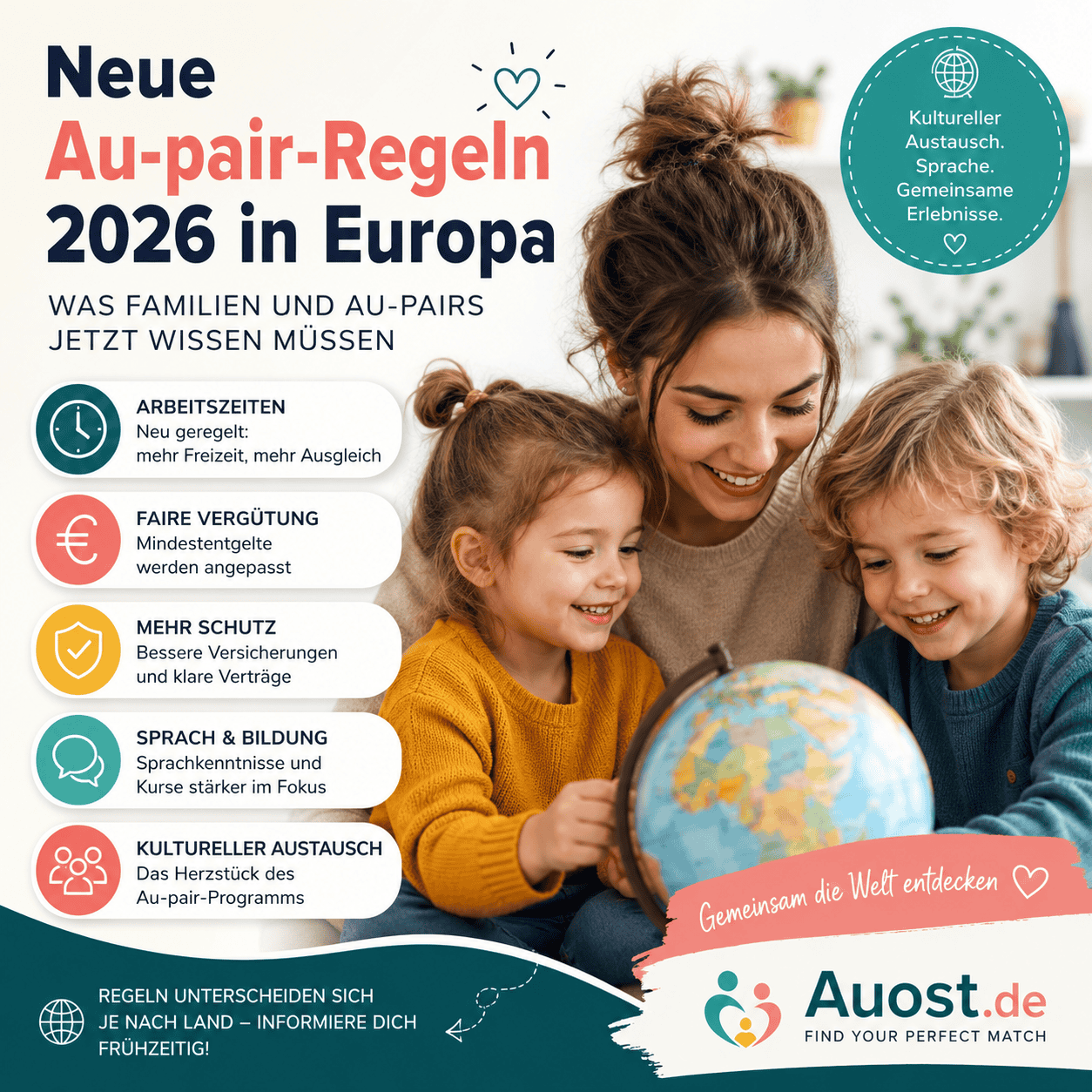
New Au Pair Rules for 2026 in Europe: What Families and Au Pairs Need to Know Now
The au pair program in Europe is undergoing a noticeable transformation. In 2026, several European countries have tightened their regulations for au pairs or have begun enforcing existing guidelines more rigorously. The focus is increasingly shifting toward fairness, cultural exchange, and the protection of young people traveling abroad as au pairs.
Consequently, for many families and au pairs, the question arises: What new au pair rules apply in Europe in 2026?
Why Europe Is Tightening Au Pair Regulations
In recent years, authorities in various countries have observed that au pairs were, in some instances, being utilized essentially as full-time nannies. As a result, the core concept of the au pair program—cultural exchange and language learning—was increasingly being overshadowed.
Therefore, in 2026, many European countries are prioritizing:
- stricter regulations regarding working hours,
- improved insurance coverage,
- clearer contractual agreements,
- language proficiency requirements,
- and stricter checks regarding visas and host families.
- Austria Introduces Strict New Rules
Particularly significant changes are taking place in Austria. As of January 2026, au pairs there are permitted to work a maximum of only 16.5 hours per week—including on-call time.
Additionally, the following regulations apply:
A minimum monthly allowance of €551.10
Mandatory insurance coverage
German language proficiency at level A1
Confirmation of notification to the AMS (Public Employment Service) for nationals of third countries
Stricter documentation requirements for host families
With these measures, Austria aims to clearly distinguish the au pair model from a standard employment relationship. Germany Tightens Visa Controls
Germany, too, is tightening its controls in 2026:
A1 language proficiency certificates will undergo more rigorous scrutiny.
Intentions regarding return to one's home country will be examined more closely.
Embassies will place greater emphasis on the completeness of application documents.
However, the fundamental rules remain largely unchanged:
- A maximum of 30 working hours per week.
- Pocket money of approximately €280 (varies among countries)
- Mandatory language courses.
- The Trend in Europe: Quality over Quantity
Countries such as France, the Netherlands, and Denmark are also increasingly prioritizing:
- Registered agencies,
- Mandatory language courses,
- Transparent contracts,
- and better preparation for host families.
Today, many families are no longer merely seeking assistance with daily chores; rather, they desire genuine intercultural experiences for their children.
This is precisely where modern platforms like Auost.de come in. Instead of cluttered Facebook groups or outdated placement models, their focus lies on safety, communication, and finding long-term, compatible matches.
Conclusion
The new Au pair regulations for 2026 across Europe send a clear message:
The Au pair program is evolving and shifting away from being merely a source of inexpensive childcare and returning to its original core concept of cultural exchange.
For families, this entails greater responsibility, but also enhanced transparency and security. For Au pairs, it establishes better protective mechanisms and clearer expectations.
Those who inform themselves early on and maintain open communication lay the best possible foundation for a successful and enriching Au pair experience.