

 Deutsch
 中文
中文
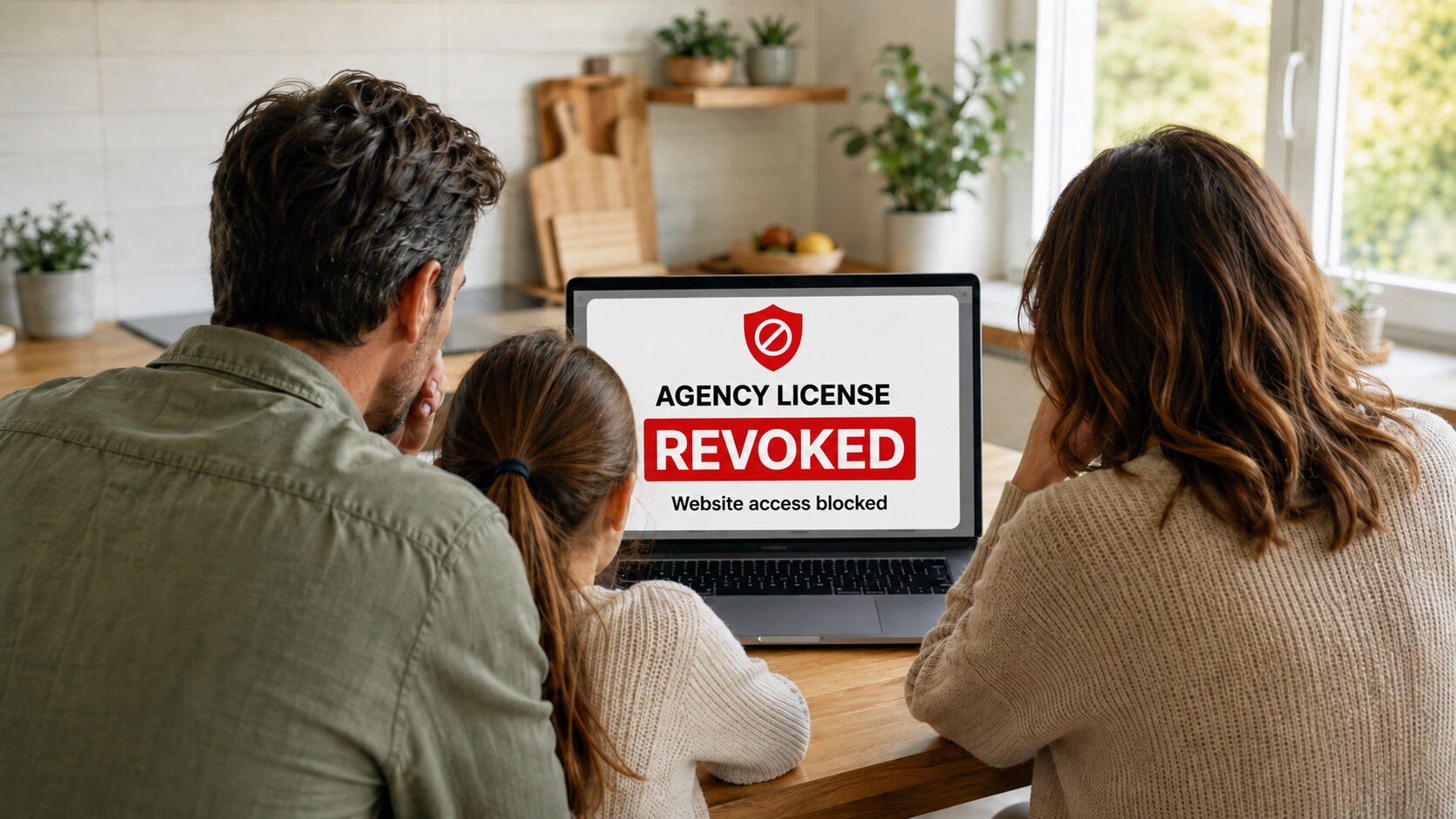
The Dutch Immigration and Naturalisation Service (IND) revoked Nina.Care’s recognised-sponsor status in September 2025. The IND said it had fined Nina.Care 48 times, for a total of more than €110,000.
The decision means Nina.Care can no longer apply for Dutch residence permits for au pairs from outside the European Union. It does not amount to a Europe-wide ban: the business may still operate as a matching platform and work with EU candidates where local law permits.
For host families, the case highlights an important lesson: a large platform, attractive website or high number of profiles is not a substitute for transparent screening, reliable emergency support and compliance with the immigration rules of the destination country.
What happened to Nina.Care?
On 5 September 2025, the IND officially announced that it had withdrawn the recognised-sponsor status of Nina.Care B.V., one of the Netherlands’ largest au pair businesses.
In the Netherlands, a recognised au pair sponsor has legal responsibilities that go beyond introducing a family to a candidate. For non-EU au pairs, the sponsor submits the residence-permit application and has information, record-keeping and duty-of-care obligations throughout the placement.
According to the IND, Nina.Care had committed a large number of repeated violations. The authority reported:
-
48 fines;
-
a total fine amount exceeding €110,000; and
-
repeated failures connected with the responsibilities of a recognised sponsor.
The IND concluded that the business had not demonstrated sufficient improvement. Nina.Care is not included in the IND’s public register of recognised au pair sponsors, last updated on 3 August 2026.
What does “licence revoked” actually mean?
News reports commonly described the decision as the loss of Nina.Care’s “au pair licence.” The more precise legal term is revocation of recognised-sponsor status.
That distinction matters.
| Question | Answer |
|---|---|
| Can Nina.Care sponsor non-EU au pairs in the Netherlands? | No. It is no longer listed as an IND-recognised sponsor. |
| Can it match EU au pairs with families? | Yes, subject to the applicable national employment and immigration rules. |
| Is Nina.Care banned throughout Europe? | No. The IND decision concerns Dutch recognised sponsorship. |
| Did the decision automatically close the company? | No. Nina.Care continued in a different, platform-focused form. |
Families should therefore avoid interpreting the decision too broadly. It is accurate to say that Nina.Care lost its Dutch recognised-sponsor status. It would not be accurate to claim, without further evidence, that the company was banned from every European au pair market.
What did the media investigation report?
Before the final IND decision, the Dutch current-affairs programme Nieuwsuur investigated complaints involving Nina.Care.
Nieuwsuur reported concerns about insufficient screening and the company’s availability when serious problems occurred. A later report alleged that prospective au pairs travelling to the United Kingdom and Germany had been advised to present themselves as tourists or “friends of the family.” Several young women were reportedly questioned, temporarily detained or refused entry.
These are attributed media findings rather than a finding in this article. Nina.Care disputed the suggestion that it instructed candidates to make false statements, but announced that it would stop recommending its “Friend of the Family” model.
How did Nina.Care respond?
Nina.Care acknowledged that its growth had outpaced its administrative capacity and accepted responsibility for earlier administrative shortcomings. The company said it had introduced stronger processes, including additional checks and emergency support.
In a May 2026 statement, Nina.Care said a court ruling reduced its fines by approximately 20% and that it intended to continue its legal challenge. However, the company’s recognised-sponsor status had not been restored in the IND’s public register as of 3 August 2026.
The company now describes itself as a technology-led European matching platform and says it is focusing on EU au pair placements.
What can host families learn from the Nina.Care case?
The most important lesson is not about one company. It is about the checks every family should complete before inviting somebody to live in their home and care for their children.
1. Check the company’s exact legal role
An au pair agency, a visa sponsor and an online matching platform are not automatically the same thing.
A matching platform helps families and au pairs find and communicate with each other. A regulated sponsor may additionally manage immigration applications and carry continuing legal responsibilities. In some countries, the family and au pair arrange the match themselves; in others, an authorised sponsor is mandatory.
Ask the provider:
-
Are you a matching platform, full-service agency or official visa sponsor?
-
Which country and authority issued your authorisation?
-
Can I verify your current status in an official register?
-
Which responsibilities remain with the family?
2. Verify authorisation directly with the regulator
Do not rely only on a logo or a statement such as “approved agency.” Open the regulator’s current register and search for the company’s complete legal name.
For example, a family bringing a non-EU au pair to the Netherlands should check the IND public register. A family using the United States J-1 programme should verify that the organisation is a current Department of State-designated sponsor.
Germany does not operate the same compulsory agency-licensing system. German families should therefore distinguish between government requirements and voluntary quality memberships such as the RAL quality mark.
3. Ask how candidates are screened
“Verified” can mean very different things on different platforms. Before matching, ask which checks have actually been completed:
-
identity or passport verification;
-
live or recorded video interview;
-
childcare-reference checks;
-
criminal-record documentation where legally available;
-
confirmation of language ability;
-
driving-experience verification when driving is required; and
-
experience with babies, toddlers or children with additional needs.
Families should also conduct their own interviews and reference conversations. No platform profile can replace direct, thoughtful communication.
4. Review emergency and rematch support
Ask what happens after the match—not only before payment.
A responsible provider should explain:
-
who can be contacted outside ordinary business hours;
-
what happens if the placement becomes unsafe;
-
how complaints are documented;
-
whether a rematch is available;
-
who assists the au pair with temporary accommodation; and
-
how visa or residence consequences are handled.
The answers should be written into the service terms, not left as informal promises.
5. Confirm the correct visa before travel
An au pair should never be told to conceal the purpose of a journey from border or immigration authorities.
Visa rules vary significantly between Germany, the Netherlands, the United Kingdom, the United States and other destinations. Families and au pairs should use official government guidance and obtain qualified immigration advice when the route is unclear.
6. Read the refund terms before paying
Check what happens if:
-
the candidate does not receive a visa;
-
the company loses an authorisation;
-
the match ends before arrival;
-
the au pair leaves early; or
-
the provider cannot deliver the agreed service.
Look for a clear refund amount, timeframe and process. Save a copy of the terms that applied on the date of payment.
7. Speak openly about expectations
Safe matching is a shared process. Before agreeing to a placement, the family and au pair should discuss working hours, childcare tasks, household responsibilities, pocket money, meals, privacy, transport, language classes, holidays and time off.
Putting these expectations in writing prevents misunderstandings and helps both sides recognise when an arrangement is no longer following au pair rules.
Agency or platform: which option is safer?
Neither label guarantees safety by itself.
A full-service agency may provide personal screening, visa management and support during the placement. A matching platform may offer a broader choice and allow families and au pairs to communicate directly. The right option depends on the destination country, the candidate’s nationality and the level of support both sides need.
The safest approach combines:
-
a transparent matching process;
-
direct conversations between the family and au pair;
-
independent verification of important information;
-
compliance with official visa rules; and
-
a clear plan for support if something goes wrong.
Finding an au pair through Auost
Auost gives host families and au pairs a structured place to create detailed profiles, review potential matches and communicate before making a decision.
Families remain in control of whom they invite into their home, while au pairs can compare families and discuss expectations directly. Where a visa, residence permit or authorised sponsor is required, both parties should follow the official rules of the destination country and involve the relevant authority or qualified provider.
The goal is not simply to find an au pair quickly. It is to create a transparent match in which the family and the au pair understand one another, feel respected and know what will happen next.
Looking for an au pair in Europe? Create your family profile on Auost, review potential matches and begin the conversation directly.
Frequently asked questions
Did Nina.Care lose its au pair licence?
Yes, in the commonly used sense of the word. More precisely, the Dutch IND revoked Nina.Care’s recognised-sponsor status on 5 September 2025. It may no longer sponsor residence-permit applications for non-EU au pairs in the Netherlands.
Why did Nina.Care lose its recognised-sponsor status?
The IND cited a large number of repeated violations. It reported 48 fines totalling more than €110,000 and concluded that the agency had not shown sufficient improvement.
Can Nina.Care still operate?
Yes. The revocation did not close the entire business. Nina.Care says it continues as a matching platform and focuses on EU au pair placements. It is not currently listed as a recognised Dutch sponsor.
Is Nina.Care banned in Germany?
No Europe-wide or German ban was identified. The confirmed regulatory decision applies to recognised sponsorship in the Netherlands.
Do au pair agencies in Germany need a government licence?
Germany does not currently require every au pair placement agency or matching platform to hold a dedicated government au pair licence. Voluntary quality certifications and memberships should not be confused with state authorisation.
How can I check whether an au pair agency is authorised?
Identify the responsible immigration or exchange authority in the destination country and search its official register using the agency’s full legal name. Do not rely solely on the agency’s website, advertising or quality-seal logo.
Is an online au pair platform the same as an au pair agency?
Not necessarily. A platform commonly facilitates profiles, searches and communication. A full-service agency may screen applicants and support placements. An official sponsor may have additional legal authority and responsibility for visa or residence applications.
Sources
-
Dutch Immigration and Naturalisation Service (IND) — “IND revokes Nina.Care’s recognised sponsor status,” 5 September 2025.
https://ind.nl/en/news/ind-revokes-nina.cares-recognised-sponsor-status -
IND Public Register Exchange — Current recognised au pair sponsors; register updated 3 August 2026.
https://ind.nl/en/public-register-recognised-sponsors/public-register-exchange -
NOS / Nieuwsuur — “Vergunning ingetrokken van grootste au-pairbureau van Nederland,” 8 September 2025.
https://nos.nl/nieuwsuur/artikel/2581686-vergunning-ingetrokken-van-grootste-au-pairbureau-van-nederland -
NOS / Nieuwsuur — “Au pairs gedetineerd en uitgezet door werkwijze omstreden au-pairbureau,” 4 September 2025.
https://nos.nl/nieuwsuur/artikel/2581106-au-pairs-gedetineerd-en-uitgezet-door-werkwijze-omstreden-au-pairbureau -
Nina.Care — Company statements concerning the IND decision, the media reports and the May 2026 court ruling.
https://www.nina.care/our-statement/ -
European Migration Network Netherlands — “Rules for au pairs are lacking in many EU Member States,” 8 August 2024.
https://www.emnnetherlands.nl/en/actueel/rules-au-pairs-are-lacking-many-eu-member-states -
BridgeUSA, U.S. Department of State — Au Pair Program and designated-sponsor requirements.
https://j1visa.state.gov/programs/au-pair
Editorial note
This article distinguishes official regulatory findings from attributed media reporting and from Nina.Care’s own statements. It does not allege criminal conduct or extend the Dutch decision beyond its documented legal scope.