



 Deutsch
 中文
中文
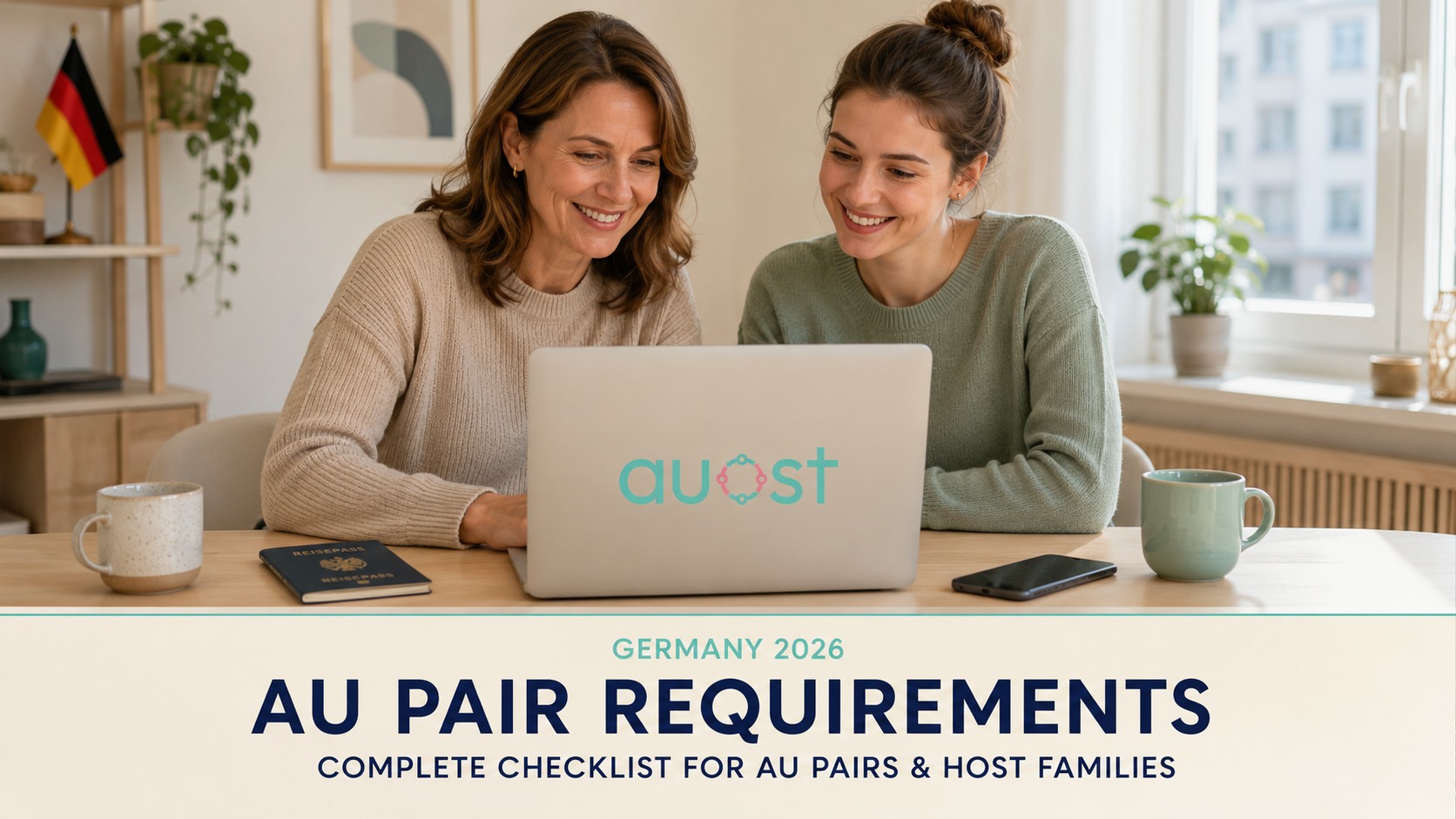
An au pair in Germany lives with a host family as part of a cultural exchange, helps care for the children and supports the family with light household tasks. In return, the family provides accommodation, meals, monthly pocket money, insurance and support for a German language course. A standard placement generally lasts between six and twelve months.
Quick answer: The host family pays €280 pocket money per month, contributes €70 per month toward an actually attended German course, pays the necessary journey to the nearest suitable course, provides free accommodation and meals, and pays the required insurance premiums. Au pair duties are normally limited to six hours per day and 30 hours per week. Visa rules depend mainly on nationality.
Auost member tip: Log in to your account and open the Program tab for detailed guidance about visa requirements, required documents, contracts, insurance and the next steps for your specific situation.
What is an au pair in Germany?
An au pair is not a full-time nanny, cleaner or professional carer. The programme is designed as a cultural exchange. The au pair becomes part of everyday family life, develops their German and learns about life in Germany while providing limited support to the host family.
Typical tasks can include:
-
looking after children, playing with them and supervising age-appropriate activities;
-
taking children to kindergarten, school or scheduled activities;
-
preparing breakfast or simple meals;
-
helping with light household tasks connected to daily family life; and
-
helping keep the children’s rooms and shared areas orderly.
Au pair duties do not include professional nursing or caring for sick or elderly relatives. Heavy cleaning, managing the entire household alone or providing unrestricted childcare is also inconsistent with the purpose of the programme.
What does an au pair cost in Germany? {#costs}
Several cost items are fixed or clearly assigned under German programme rules. Other costs depend on the family, location and insurance policy.
| Cost item | Amount | Usually paid by | Important detail |
|---|---|---|---|
| Pocket money | €280 per month | Host family | Paid regardless of whether all 30 permitted hours are used. It is pocket money, not a salary. |
| Language-course contribution | €70 per month | Host family | Payable when eligible course expenses are actually incurred; €840 for a full 12-month placement. |
| Travel to the language course | Variable | Host family | Necessary travel to the nearest suitable German course is paid in addition to the course contribution. |
| Health and accident insurance | Variable | Host family | The policy must cover sickness, pregnancy and birth, and accidents. |
| Accommodation and meals | Variable | Host family | A suitable room and full board are provided free of charge. |
| Travel to and from Germany | Variable | Usually the au pair | Unless the family voluntarily agrees to contribute. |
| National visa application | Normally €75 | Usually the applicant | Reductions or exemptions may apply. |
| Platform or agency services | Variable | Depends on provider | Costs depend on the selected service or membership. |
For a 12-month placement in which language-course costs are incurred, pocket money and the course contribution together total €4,200: €3,360 pocket money plus €840 for the language course. This is not the full annual cost. Families must also budget for insurance, course travel, food, utilities, accommodation and any optional service fees.
The au pair’s room and meals are not deducted from pocket money. A realistic family budget may also include local transport, a SIM card, family outings, holiday arrangements or other benefits agreed in advance.
Who pays for au pair insurance?
The host family must take out and pay for insurance covering illness, pregnancy and birth, and accidents. Liability cover is commonly recommended as well, but the exact policy wording and exclusions should be checked before the placement begins.
For a more detailed calculation, read: What Does an Au Pair Cost in Germany?
What requirements apply? {#requirements}
The requirements protect both sides and preserve the cultural-exchange character of the programme. They cover age, language, family composition, duration, accommodation, working time and the written agreement.
Requirements for the au pair
-
Age: For a third-country au pair visa or residence permit, the applicant must generally be at least 18 and must not yet have turned 27.
-
German: Basic German is expected—normally at least CEFR level A1 for the visa or residence process.
-
Duration: A standard placement lasts at least six months and no longer than twelve months.
-
Relationship: The au pair must not be related to the host family.
-
Role: The au pair supports childcare and light household tasks. The position is not professional care work or full-time domestic employment.
-
Documents: A valid passport, written contract and—where applicable—a visa or residence authorisation are required.
Requirements for the host family
-
At least one child under 18 must live continuously in the household. Couples and single parents can qualify as host families.
-
For third-country approval, German is normally spoken as the family’s native language. Approval may also be possible when German is the normal family language and the au pair does not come from a home country of the host parents.
-
Under Federal Employment Agency guidance for third-country placements, at least one adult family member should be a German, EU/EEA or Swiss citizen.
-
The au pair should normally receive a suitable private room in the family home and meals on the same basis as family members.
-
The schedule must leave time for a German course, cultural events and religious activities.
-
Both sides should sign a written au pair agreement before the placement and define duties, hours, pocket money, insurance, holiday and notice arrangements.
Working hours, free time and holiday
| Rule | German programme standard |
| Maximum duties | Six hours per day and 30 hours per week, including childcare. |
| Overtime | Only occasionally and by prior agreement; it should be compensated with time off. |
| Weekly time off | At least 1.5 full days per week. |
| Free evenings | At least four evenings per week. |
| Sundays | At least one Sunday per month should be free. |
| Paid holiday | Four weeks for a full 12-month placement, or two working days for every full month. |
Legal eligibility is only the first step. Before matching, discuss the actual weekly schedule, children’s routines, driving expectations, dietary needs, pets, additional support needs, language-course times, transport, family holidays, privacy, guests and how problems will be resolved.
For the full checklist, read: Au Pair Requirements in Germany
Is a visa required? {#visa}
Whether an au pair needs a visa depends mainly on nationality. A short-stay Schengen visa or visa-free visitor status does not automatically permit au pair work. The residence document must expressly authorise the au pair activity before work begins.
| Nationality group | Visa before entry? | What happens next? |
| EU/EEA and Swiss citizens | No visa or Federal Employment Agency work approval is required. | Register the address locally and make sure the contract and insurance are in place. |
| Most other nationalities | Yes. Apply for a national D visa for au pair employment before travelling. | After arrival, register the address and apply for the relevant residence permit before the entry visa expires, if required. |
| Australia, Canada, Israel, Japan, New Zealand, South Korea, the UK and the USA | These citizens can generally enter without a visa and apply for the residence permit in Germany. | They may not begin au pair duties until the residence permit expressly authorises the work. Applying before travel can avoid a delayed start. |
How the visa process usually works
-
Confirm the au pair’s age, German level, nationality, proposed duration and the host family’s eligibility.
-
Agree on duties, working hours, accommodation, language-course arrangements, pocket money and insurance.
-
Sign the au pair contract and complete the host-family questionnaire.
-
Check the exact checklist and appointment procedure of the responsible German mission.
-
Submit the application. Typical documents include the passport, application form, biometric photo, contract, host-family questionnaire, proof of basic German and insurance information. The mission may request additional documents.
-
Wait for the decision and any necessary Federal Employment Agency approval.
-
After arrival, register the German address and obtain the required residence permit before the entry visa expires. Do not begin work until the residence document allows au pair employment.
Detailed visa guidance: Log in to your Auost account and go to the Program tab for detailed information about visa requirements, required documents, insurance, contracts and the next steps for your specific placement.
For the step-by-step guide, read: Au Pair Visa for Germany
Frequently asked questions
How much pocket money does an au pair receive in Germany?
The official monthly pocket-money amount is €280. It is paid regardless of whether the family uses all permitted hours.
Who pays the insurance?
The host family pays the premiums for insurance covering sickness, pregnancy and birth, and accidents.
How many hours may an au pair work?
Au pair duties, including childcare, are normally limited to six hours per day and 30 hours per week.
Does an au pair need German before arriving?
For third-country visa or residence approval, basic German is expected, normally CEFR level A1.
What is the age limit?
Applicants must generally be at least 18 and must not yet have turned 27 when the residence decision is made.
Does every au pair need a visa?
No. EU/EEA and Swiss citizens do not. Most third-country nationals need a national visa before entry, while a limited group of nationalities may apply for a residence permit after visa-free entry.
How much paid holiday does an au pair receive?
A full-year placement includes four weeks of paid holiday. Shorter placements generally provide two working days for every full month.
The right preparation makes the difference
Costs and visa rules matter, but a successful au pair year depends just as much on realistic expectations. Families should describe their real routine honestly, and au pairs should ask specific questions about the children, schedule, course, room, transport and free time before accepting a match.
With a transparent profile, a written weekly plan and the correct documents, both sides can begin with greater confidence—and focus on what the au pair experience is intended to offer: cultural exchange, language learning and meaningful support in everyday family life.
Your next step: Create or update your Auost profile, compare compatible matches and use the Program tab for detailed guidance throughout your placement.